In one paragraph
When people don’t do what a product needs, one of four things failed: they didn’t notice (trigger), couldn’t (ability), didn’t want to (motivation), or didn’t see it worked (value evident). Each barrier needs a different fix; The Behavioral Handbook organizes its strategies by these four.
They told you they loved it. So why won’t they use it? Before you blame the users, run the diagnosis. A behavior happens when a trigger is noticed and, at that very same moment, the person is able enough and motivated enough to act (that’s B.J. Fogg’s Behavior Model, the engine under both books). And it keeps happening only if they notice it paid off. Find which of the four is missing and you know which chapter to open.
1. They didn’t notice (triggering)
This is the one founders forget. They picture the user weighing the option and deciding no. Most of the time the user never got that far: nothing reminded them the option existed. And a signal has to survive three tests in a row: be noticed above the noise, be understood and believed, and land at a moment when they can and want to act.
The chapters and the question each one asks
- Chapter 1, Saliency. Can they notice it above the noise?
- Chapter 2, Decoding & Trust. Can they instantly understand it?
- Chapter 3, Opportunity. Is the ability + motivation pair above the line right now?
Strategies to try (working names from the Handbook)
ContrastAnchor to what they already knowKnow when not to fire
2. They couldn’t (ability)
If it’s impossible, or just hard enough to feel impossible, motivation can’t rescue it. Ability comes in three kinds that fail separately: knowing how (cognitive), the body doing it (physical) and having the time, money or tools at hand (resource). Find which one is blocking before you reach for a tool: training someone who lacks the resource is the classic waste.
The chapters and the question each one asks
- Chapter 4, Cognitive Ability. Is it mentally easy: low knowledge, low thinking?
- Chapter 5, Physical Ability. Is the bodily action easy: low dexterity, few steps?
- Chapter 6, Resource Ability. Do they have the time, money and tools at the right moment?
Strategies to try (working names from the Handbook)
One thing at a timeCut the movementsProvide the resource directly
3. They didn’t want to (motivation)
Ease without a reason goes nowhere. Motivation is the promise of value, weighed before the effort is spent, and The Behavioral Startup sorts what people find valuable into three kinds of need, from Clayton Alderfer’s ERG theory: existence, relatedness and growth. One warning: “they just don’t want to” is the most over-diagnosed condition in product design. Rule out triggering and ability first.
The chapters and the question each one asks
- Chapter 7, Existence. Survival, stability, security, money, time, certainty.
- Chapter 8, Relatedness. Belonging, status, esteem, recognition, connection.
- Chapter 9, Growth. Mastery, progress, achievement, purpose, self-actualization.
Strategies to try (working names from the Handbook)
Promise it with certaintyShow others doing itGive them a taste
4. They didn’t see it worked (value evident)
Even when they act, the machine only keeps running if they notice the value they got back. Effort that pays off invisibly feels, to the brain, exactly like effort that didn’t pay off at all. Two things break it: value that’s invisible (it landed somewhere they can’t see) and value that’s late. Motivation gets them to start; value evident makes them come back.
The chapters and the question each one asks
- Chapter 10, How to Make Value Evident. Did they notice it worked?
Strategies to try (working names from the Handbook)
Close the loopDeliver it fastShow the before against the after
In what order?
Triggering first, then ability, then motivation. If they never notice, their ability and motivation are irrelevant. If it’s too hard, motivation rarely rescues it. And people mostly agree on what’s hard but disagree wildly about what’s worth it, so fix the cheap, agreed-upon stuff first. Value evident is what makes the next time easier: every closed loop feeds the trigger, the ability and the motivation for the next turn.
The Handbook adds three more parts: driving a behavior the other way (friction and deterrence), system and time, and how to measure whether a fix worked. And a fair warning, straight from its first pages: none of this is a guarantee. Each strategy is a good first guess, and then a thing to test on your actual users.
New to the words? The glossary has them all, and what is behavioral design? puts them together.
Start with the first barrier
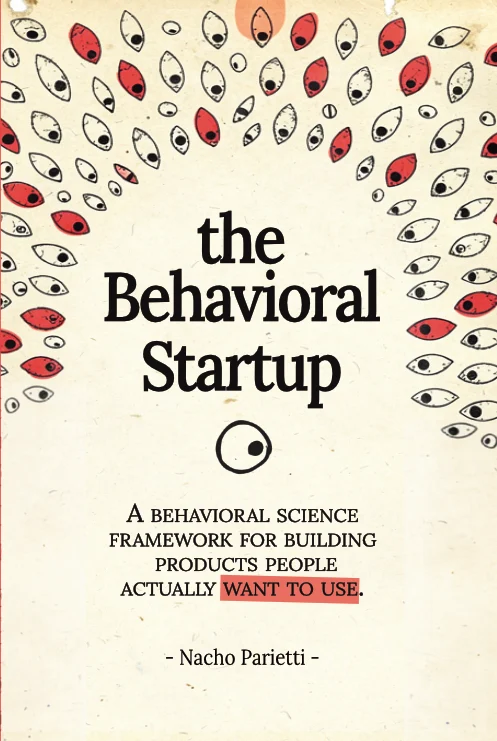
Chapter 1 of The Behavioral Handbook, Saliency, is free: can they notice it above the noise? And if you haven’t mapped your product’s behaviors yet, The Behavioral Startup is the method to do it.
Read chapter 1 free Get The Behavioral Startup